
ISO 15189:2022 – Medical Laboratory Quality & Accreditation
Quality Assurance Across the Laboratory Testing Process: Pre-Examination, Examination and Post-Examination Phases
SPEA Approved Certificate
Overview
Practical approaches to ensuring laboratory process quality, reducing errors, and improving result reliability and patient safety throughout the testing process.
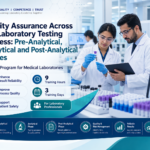
- This training course provides a practical understanding of quality assurance across the three phases of the laboratory testing process: pre-examination, examination, and post-examination. It focuses on improving result reliability and reducing errors that may affect clinical decisions and patient safety.
- The course addresses examination requests, accurate patient identification, specimen collection, transportation, receipt and handling, analytical process control, result validity, laboratory report review and release, and critical result communication. Essential control points are introduced for each phase.
- Drawing on relevant quality and competence principles of ISO 15189:2022, the course uses practical examples, case studies, and performance indicators to help participants identify error sources, assess risks associated with laboratory workflows, and recognize opportunities for improvement.
- Designed for medical laboratory personnel, quality officers, and laboratory supervisors, the course emphasizes an integrated approach to quality throughout the total testing process. Advanced internal quality control statistics, measurement uncertainty estimation, and detailed examination method validation and verification are covered in separate specialist programs.
- This professional development course does not grant formal laboratory accreditation.
Who Should Attend
- Medical laboratory managers and technical department supervisors.
- Laboratory quality managers and quality officers.
- Medical laboratory scientists and technicians.
- Personnel involved in specimen reception, phlebotomy, transportation, and processing.
- Professionals responsible for laboratory result review, reporting, and release.
- Members of laboratory and hospital quality improvement and error reduction teams
Learning Outcomes
- By the end of the course, participants will be able to: Explain the phases of the laboratory testing process and identify essential quality requirements for each phase.
- Apply appropriate practices for patient identification, specimen collection, transportation, reception, acceptance, and rejection.
- Identify critical control points during the examination phase to support reliable analytical processes and results.
- Explain procedures for result review, verification, report release, and critical result communication.
- Identify error sources across the testing process and assess their impact on result quality and patient safety.
- Use quality indicators and case-based analysis to identify improvement opportunities and develop appropriate corrective actions.
Course Outline
-
Module 1: Quality Assurance in the Pre-Examination Phase
• Examination requests and patient identification. • Specimen collection, transportation, and preservation. • Specimen acceptance, rejection, and error management.
-
Module 2: Quality Assurance During the Examination Phase
• Equipment, reagent, and examination method readiness. • Principles of internal and external quality control. • Managing deviations and unacceptable results.
-
Module 3: Quality Assurance in the Post-Examination Phase
• Result review and verification. • Report preparation, release, and critical result communication. • Error management and report corrections.
-
Module 4: Quality Indicators and Continual Improvement
• Identifying errors and quality indicators across testing phases. • Root cause analysis and corrective actions. • Practical applications for laboratory process quality improvement.
Assessment
• Short knowledge checks on quality requirements across the testing phases. • Case study tracing a laboratory specimen workflow. • Exercise on identifying, classifying, and analyzing laboratory errors. • Activity on developing quality indicators and an improvement plan. • Final assessment of the intended learning outcomes.